![[personal profile]](https://www.dreamwidth.org/img/silk/identity/user.png) poliphilo
poliphiloThe Cuckoo Trail is a disused railway line, now repurposed as a walkway and cycle path, which runs from Heathfield, through Horam, Hellingly and Hailsham, to end- breaking the sequence of aitches- in Polegate. A few weeks back we took a stroll down a section near Horam, yesterday we did the same at Hellingly.
The path was busy, busier than it had been on our previous excursion. Lockdown? What lockdown?
Hellingly is a pretty village- and growing. The path took us past a huge housing estate that is in the process of going up. It lies below the level of the path- on meadows which I'll bet are water meadows. There were some very big puddles down there. "You're going to have problems with flooding," I thought to myself.
The Area around Hellingly church is as English-idyllic as they come.
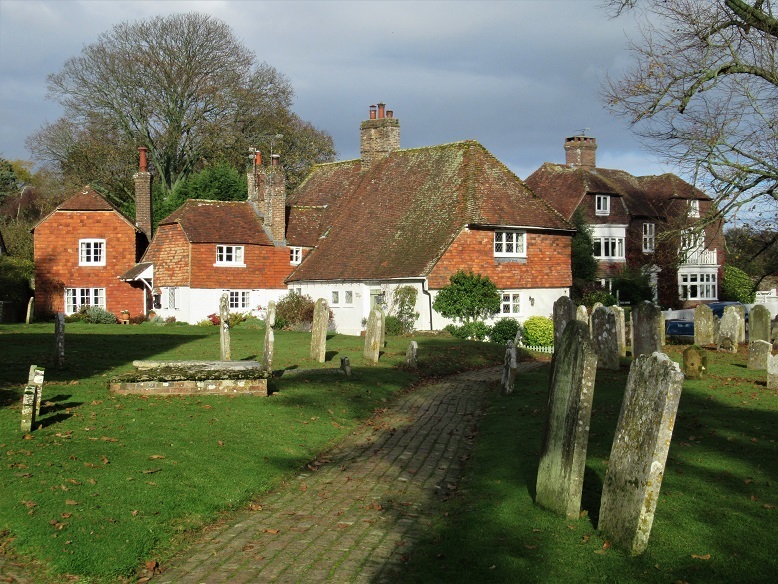
The house at the centre of the picture is called Prior's Grange- which suggests there was once a Priory in the neighbourhood. Note the paths: they were laid by unemployed labourers in 1824- and are still perfectly good. The churchyard is circular, which you'd be unlikely to guess unless you viewed it from a flying machine- and is raised six feet above the surrounding area. This is a configuration the Saxons used to favour- and there's even a name for it- which is "cric". The pamphlet I got this information from suggests they didn't like to think of their ancestors getting wet.
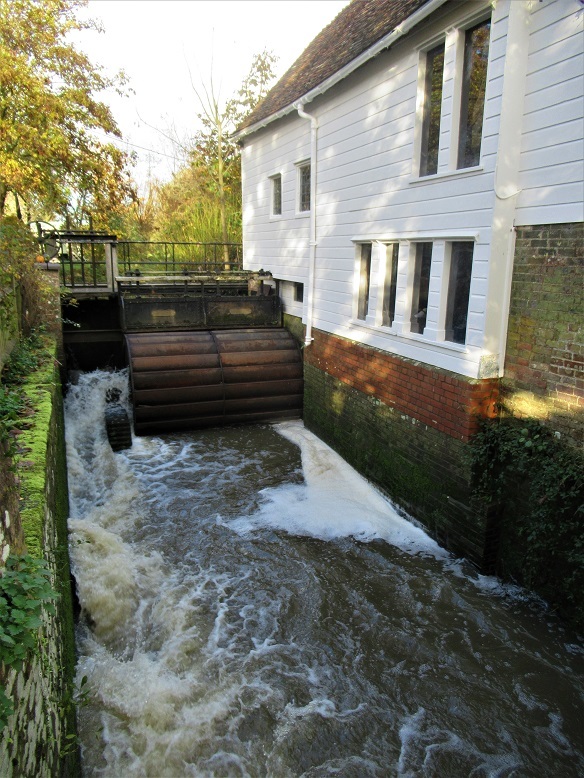
Like I said, it's not an area I'd want to be building houses in. There's a river runs through it- the Bull river- which feeds into the Cuckmere. And look- here's the water mill.
The path was busy, busier than it had been on our previous excursion. Lockdown? What lockdown?
Hellingly is a pretty village- and growing. The path took us past a huge housing estate that is in the process of going up. It lies below the level of the path- on meadows which I'll bet are water meadows. There were some very big puddles down there. "You're going to have problems with flooding," I thought to myself.
The Area around Hellingly church is as English-idyllic as they come.
The house at the centre of the picture is called Prior's Grange- which suggests there was once a Priory in the neighbourhood. Note the paths: they were laid by unemployed labourers in 1824- and are still perfectly good. The churchyard is circular, which you'd be unlikely to guess unless you viewed it from a flying machine- and is raised six feet above the surrounding area. This is a configuration the Saxons used to favour- and there's even a name for it- which is "cric". The pamphlet I got this information from suggests they didn't like to think of their ancestors getting wet.
Like I said, it's not an area I'd want to be building houses in. There's a river runs through it- the Bull river- which feeds into the Cuckmere. And look- here's the water mill.


no subject
Date: 2020-11-11 10:24 am (UTC)no subject
Date: 2020-11-11 10:25 am (UTC)no subject
Date: 2020-11-11 12:57 pm (UTC)The raising of the courtyard by 6 feet may also account a little for the pathway lasting that long, since if rain water naturally flows off due to the elevation, the path may not be at as much risk of sinking over time into moist earth. Just a guess.
no subject
Date: 2020-11-11 01:08 pm (UTC)I reckon you're right about the path.
no subject
Date: 2020-11-11 05:30 pm (UTC)What does the village name mean, do you know? Something to do with holiness or light? Or is it just the village of all things horrible? I live in HELLsinki myself, where the sleet beats at your face and everyone's favourite colour is black. XD
no subject
Date: 2020-11-11 07:34 pm (UTC)The single word "hell" means grave or burial place. I wonder whether the Hel in Helsinki has the same meaning.
no subject
Date: 2020-11-11 08:40 pm (UTC)Our city (or town) was founded in the 1600s and the etymology of it is not known. The name itself is of Swedish origin and refers to the rapids that flow through the city (Helsingfors). I had to check in Wiki and the Finnish version only says that the etymology is too vague to reach while the English version suggests that the name may be derived rom "hals" which (still means) neck, referring to the rapids again.